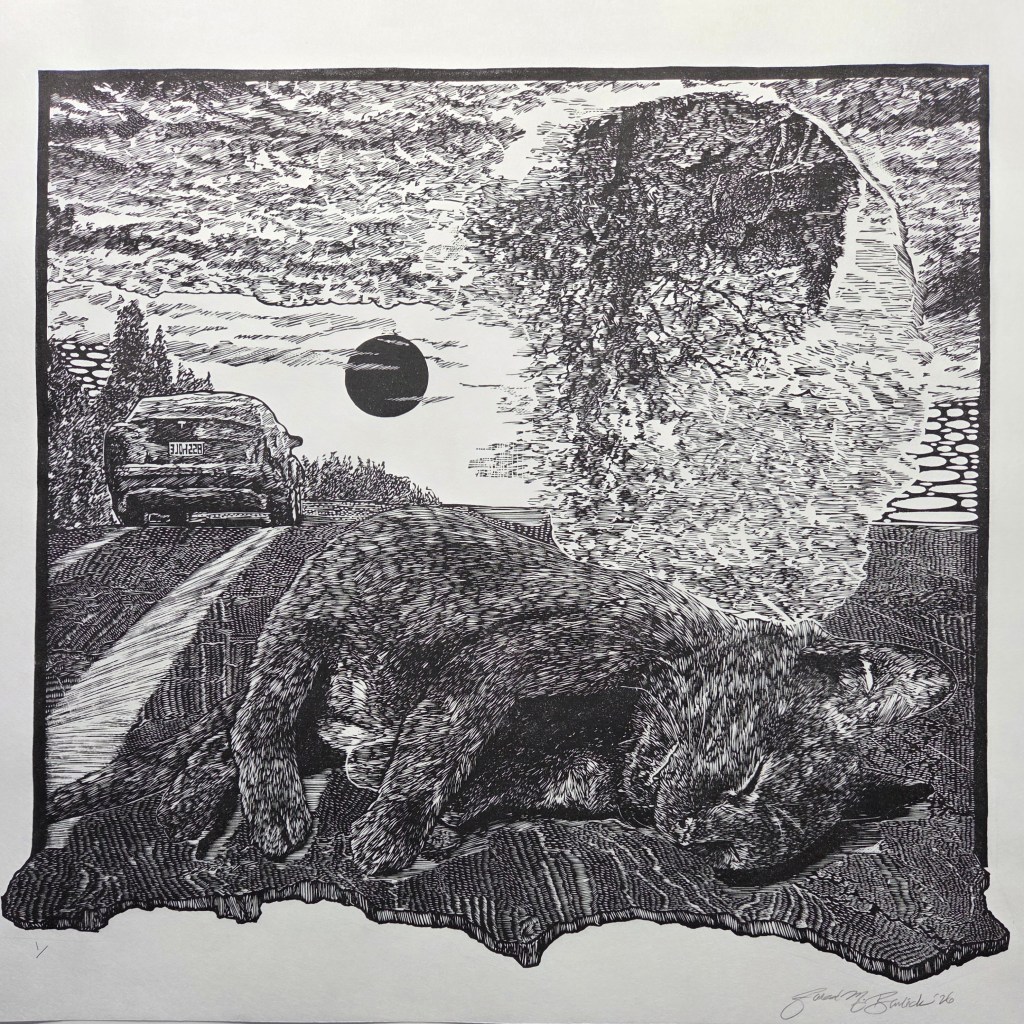
New Woodcut Addressing: Animals Who Die Hit by Cars Without Punishment or Proper Treatment of the Animal

1. How It Started:

  • This started after years of watching animals die via vehicle collision and the owners of vehicles were never held accountable and the animal was often left there to rot on the roadside without any proper burial or consideration.

2. How I Determined the Narrative Focus:

  • I spent months planning, shooting photos of roadkill and 3 years driving the state from Fresno to the Bay and Fresno to San Diego observing patterns of human behavior regading animals killed by cars, coupled with seeing this play out in my own community year over year for 20 years.

3. So the questions became:

  • How do I convey the message that people need to see the animals as important as people?
  • How do I make people engage with a dead animal on paper?
  • How do I create a work that tells a narrative while at the same time forces the people to consider their actions?
  • ***I also knew I had to try some new elements in this work, and I was not sure how to render that? (i.e. the upside down transition to Heaven; the asphalt and a car speeding away)

4. How it Became a Drawing:

  • I was able to narrow down that the best animal was a kitten. Older animals that die this way are not pretty or can be very damaged, and people would not look at that.
  • I knew I wanted a comment on Waymo & Tesla after the Waymo killed a well-known and loved cat and a Tesla hit a Sherrif vehicle.
  • The clouds would be a new attempt to expand my style off of the reproductive rights storm clouds.
  • The ground would break forward through the frame/border to bring you up close to the cat.

The Challenges:

  • The upside down image not being lost in the existing sky/clouds
  • Creating the image of asphalt and a black cat where the cat is discernible.
  • Perspective of the car and tire marks in the wet road (figuring out how to let go of perspective and what would be “real” and in size for the sake of the image.
  • Creating a new way of doing storm clouds

New Woodcut Responding to Norman Rockwell’s “Freedom from want” 1943

1. How It Started:

  • This started from a 30-year observation from living with families who were poor/struggling coupled with 20 years of teaching in lower-socio-economic communities. There was always a gross disparity between rich and poor that bugs me.

2. How I Determined the Narrative Focus:

  • After weeks of planning and months of reviewing artworks used as propaganda to manipulate people through false messaging, Norman Rockwell’s 1943 work titled “Freedom from Want” of the “Four Freedoms” series inspired by FDR’s Four Freedoms speech had to be addressed. Initially pitched to the War Department and Office of War Information (rejected) and done for the 𝘚𝘒𝘡𝘢𝘳π˜₯𝘒𝘺 𝘌𝘷𝘦𝘯π˜ͺ𝘯𝘨 π˜—π˜°π˜΄π˜΅, this work was used by the media and the Federal Government to push a false narrative to the public whose lives don’t, won’t, and in some cases can’t look like this. In 1943, the media and US Gov’t wanted to sell us a false reality of what life for people could, and will look like. And, since Trump’s second term, this reality has become even further from attainable.

3. So the questions became:

  • How do I convey the message of where we are heading under the 2025 administration?
  • How do I create a work that operates as a clear response to his work while at the same time operating as a prediction of what’s to come under this leadership?

4. How it Became a Drawing:

  • I knew I had to keep the propaganda poster in tact with the same wording.
  • I knew I wanted treat this as a post American-Moral-Apocalypse piece so gas-masks were necessary, especially since the genocide of Palestine is being supported/fueled by the American government.
  • The year I am predicting is like Huxley in Brave New World – about 109 years into the future. But in my case, I am predicting 50 years of so. So my future year is 2075.
  • Kids would not be affordable to have – so I removed them.
  • The elderly don’t live past mid 60’s so they are removed as well.
  • The rich would have had to sell their fancy art to survive, so the art is removed from the wall.
  • The fine glassware stays, but just water. No food. Now even the rich are living on military rations, but not enough for everyone.

The Challenges:

  • Rockwell’s piece plays with masterful work in the white tones, so I’m trying to respect that work and represent it in a woodcut
  • Keeping the semblance of light passing through thin linens